Understanding Calibers: Cartridges, Gauges and Matching the Right Ammunition

October 17, 2026
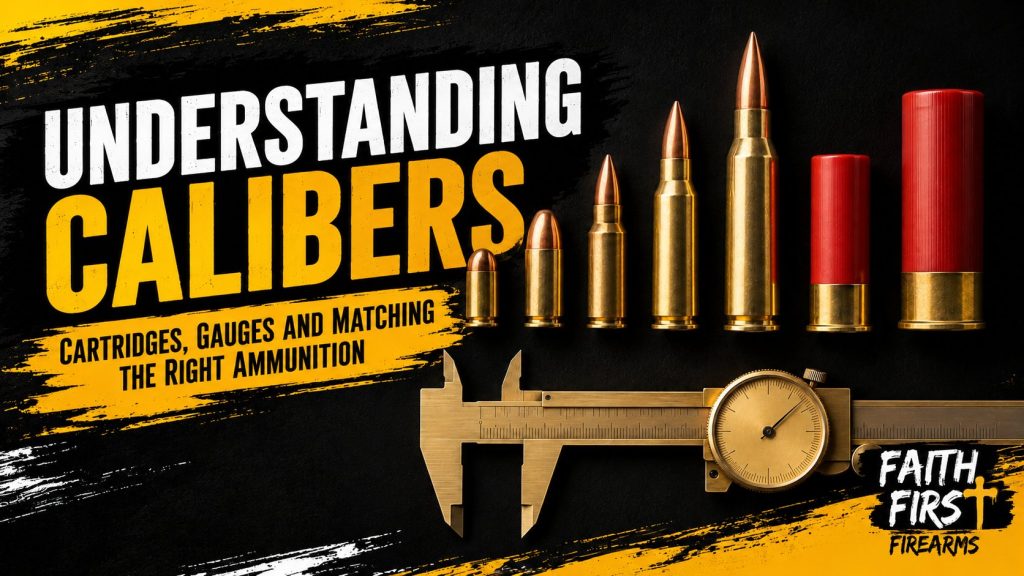
Banner for understanding calibers: five cartridges of increasing size and two shotgun shells in a row above a brass dial caliper.

“Caliber” is one of the first words a new firearm owner learns and one of the most loosely used. People use it to mean the width of a barrel, the name of a cartridge, and sometimes simply how big a gun feels. Those are three different things, and the difference matters for more than vocabulary.

The most important ammunition rule is that a firearm should be fed only the exact cartridge or gauge it is marked for. This guide explains how ammunition is named, how to read the markings on a firearm and a box, which pairings are known to be dangerous, and how to think through a caliber choice without being sold one.

Caliber, Cartridge and Gauge: Three Different Words

  • Caliber is a measurement. SAAMI defines it as the approximate diameter of a rifled barrel’s bore, measured across the tops of the rifling, usually expressed in hundredths of an inch (“.38 caliber”) or in millimeters (“9mm”).
  • Cartridge is the complete round: case, primer, powder and bullet, built to one standardized design. “9mm Luger” and “.38 Special” are cartridge names.
  • Gauge is the term used to identify most shotgun bores, and the numbering runs the opposite way from what you might expect: a 12-gauge bore is larger than a 20-gauge bore. The .410 is the common exception, named by its bore diameter rather than a gauge number.

In everyday conversation, “What caliber is it?” usually means “Which cartridge does it fire?” That works at the counter. When you are loading a firearm, the full cartridge name is what counts.

Why the numbers don’t always match

Cartridge names carry a lot of history. The number in a name is not always the actual bullet diameter, and unrelated cartridges can share similar numbers. The .38 Special and the .357 Magnum use bullets of essentially the same diameter, and several different cartridges include “9mm” in their names. Treat the full name, every word and number, as the identifier rather than the first figure alone.

How to Read the Markings

On the firearm

The manufacturer marks the cartridge or gauge on the barrel, frame or receiver. Shotguns are usually also marked with a chamber length, such as 2¾″ or 3″. Your owner’s manual confirms what the firearm is designed to fire and is the final word whenever a marking is unclear.

On the ammunition

The box label names the cartridge, and so does the headstamp: the lettering stamped into the base of each case or shell, which SAAMI describes as identifying the manufacturer and the caliber or gauge. SAAMI’s rule is to confirm that the designation on the headstamp matches the designation marked on the firearm, such as 9mm Luger ammunition in a firearm marked 9mm Luger, or 12-gauge shells in a shotgun marked 12 gauge.

When the markings don’t help

If a firearm’s markings are missing, unreadable or appear altered, which is not unusual with older or inherited firearms, do not guess. SAAMI’s guidance is to have the firearm examined by a qualified person before using any ammunition in it. The same applies to loose rounds with no box: if you cannot identify them with certainty, do not fire them.

Pairings That Are Accepted, and Pairings That Are Dangerous

SAAMI is direct about this: the fact that a cartridge fits into a chamber does not make it safe to fire. A mismatched round can create pressure the firearm was never built to contain, and the result can seriously injure the shooter and bystanders.

Combinations SAAMI lists as generally accepted

  • .38 Special in a revolver chambered for .357 Magnum, but not the reverse.
  • .44 Special in a revolver chambered for .44 Magnum, but not the reverse.
  • .223 Remington in a rifle with a military-specification 5.56 chamber. Because many non-military “5.56” chambers exist, SAAMI still recommends confirming with the owner’s manual or the manufacturer.

Combinations SAAMI identifies as unsafe

  • 5.56 NATO ammunition in a barrel marked .223 Remington. The .223 Remington chamber has a shorter throat into the rifling, which can raise pressure.
  • .357 Magnum ammunition in a revolver marked .38 Special.
  • A 20-gauge shell in a 12-gauge shotgun. The smaller shell can slide forward and lodge in the barrel, where a 12-gauge shell loaded behind it can cause a burst. SAAMI warns about the same problem with 16-gauge shells in a 12-gauge and 28-gauge shells in a 20-gauge.

The practical defense is organization. Keep each cartridge in its labeled box, keep different shotgun gauges in separate bags or containers, and read the headstamp as you load. Some ammunition is also loaded to higher pressure and marked “+P”; use it only if the owner’s manual says the firearm is rated for it.

Common Cartridges You Will See, in Plain Terms

This is orientation, not a ranking. Each cartridge below is widely available and used successfully by many owners. What fits you depends on your purpose, the firearm, and what you can shoot accurately and practice with regularly.

Handgun cartridges

  • .22 LR: a rimfire cartridge with very light recoil, widely used for learning and practice.
  • .380 ACP: common in small, light pistols. The cartridge itself is mild, though a very small pistol can still feel snappy.
  • 9mm Luger (also labeled 9×19mm): a centerfire pistol cartridge offered in a wide range of pistol sizes.
  • .40 S&W and .45 ACP: larger centerfire pistol cartridges; recoil and pistol size generally increase.
  • .38 Special and .357 Magnum: classic revolver cartridges. A revolver chambered for .357 Magnum can also fire .38 Special.

Rifle cartridges

  • .22 LR: the same rimfire cartridge, common in light rifles used for practice.
  • .223 Remington and 5.56 NATO: related but not identical; see the safety notes above.
  • .308 Winchester and other larger centerfire cartridges: commonly used for hunting and longer-range shooting.

Hunting rules, including what may be used for a given species, are set by state wildlife agencies; in Texas, that is the Texas Parks and Wildlife Department. Check the current regulations before a hunt rather than relying on general articles, including this one.

Shotgun gauges

  • 12 gauge: a widely used gauge with a broad range of loads.
  • 20 gauge: a smaller bore that generally produces less recoil in a comparable shotgun.
  • .410 bore: the smallest of the three, light in recoil but with a small payload.

Shotgun shells also come in different lengths and loads, and birdshot, buckshot and slugs serve very different purposes. Always match the gauge, and make sure the shell is no longer than the chamber length marked on the shotgun.

How to Think Through a Caliber Choice

There is no universally right answer, and an article that hands you one is usually selling something. A better approach is to settle a few questions first:

  • Purpose. Home, carry, range, hunting and property each lean toward different firearms and cartridges, and our Shop by Purpose pages are organized around exactly that question.
  • Control. The right cartridge is one you can shoot accurately and comfortably enough to practice with. A lighter, smaller firearm will feel sharper recoil than a larger one firing the same cartridge.
  • Practice. Skill comes from repetition, so consider how readily you can find practice ammunition for the cartridge you choose.
  • Household. If more than one person may use the firearm, choose with every user’s hands and comfort in mind.

The most useful step is to try before you decide. Many ranges rent firearms in several cartridges, and our guide to your first visit to a shooting range explains what to expect.

If you are also weighing a revolver against a semi-automatic pistol, our comparison of the two covers that decision separately.

One Habit That Prevents Most Mistakes

Keep ammunition in its factory box, one cartridge type per box, and read the headstamp every time you load. It takes seconds, and it removes the most common way a sound firearm and good ammunition become a dangerous combination. If you have never handled a particular firearm or cartridge before, ask someone qualified to walk you through it first.

Sources

  • SAAMI, Glossary: “Caliber,” “Cartridge,” “Gauge” — saami.org
  • SAAMI, Glossary: “Headstamp” — saami.org
  • SAAMI, Generally Accepted Firearms and Ammunition Interchangeability — saami.org
  • SAAMI, Unsafe Firearm–Ammunition Combinations (advisories) — saami.org
  • SAAMI, Frequently Asked Questions — saami.org
Educational Information

This content is provided for general educational purposes and is not legal advice. Firearm laws and regulations may change and can vary by jurisdiction. Verify current federal, state, and local requirements before acting.

About the Faith First Firearms Editorial Team

Our articles are written and reviewed by the Faith First Firearms Editorial Team. We cite primary sources where a claim depends on one, we say plainly when a question falls outside what we can answer, and we route legal, medical, and instruction questions to people qualified to answer them. Faith First Firearms does not provide firearm training.

Faith. Safety. Responsibility.
Continue Learning

Banner for long-term firearm maintenance: a cleaning rod, bronze bore brushes, cotton patches, gun oil and a microfiber cloth on a black cleaning mat.
Moisture and neglect do more damage than shooting. Safe cleaning habits, long-term storage prep and seasonal checks that keep a firearm reliable for years.
October 17, 2026
Banner on ammunition storage: a sealed metal ammo can, plain ammunition boxes, a desiccant canister and a hygrometer on a shelf inside a storage cabinet.
Moisture, heat and chemicals do the real damage. Here is how to store ammunition so it stays dry, locked away and reliable for years.
October 17, 2026
Banner for Faith, Safety, Responsibility in daily firearm ownership: a man checks a handgun at a table beside an open locking case, with a home gun safe behind him and a child reading on a sofa in the background.
The mission is closer to an order of operations than a posture. In ordinary ownership it lands in four decisions, and most owners have genuinely finished two of them.
August 9, 2026

Prefer personal guidance on ownership, transfers, or your first purchase? Book a consultation.

Access Denied

You have told us that you are under 18 years old, so we are not able to give you access to this site.

If you would like to learn about firearm safety and responsible ownership, Project ChildSafe offers free educational resources:

Project ChildSafe — firearm safety education

Age Verification Required

I confirm that I am at least 18 years old.

Age confirmation does not determine eligibility to purchase or receive a firearm. Additional federal, state, local, product-specific, and transfer requirements may apply.