
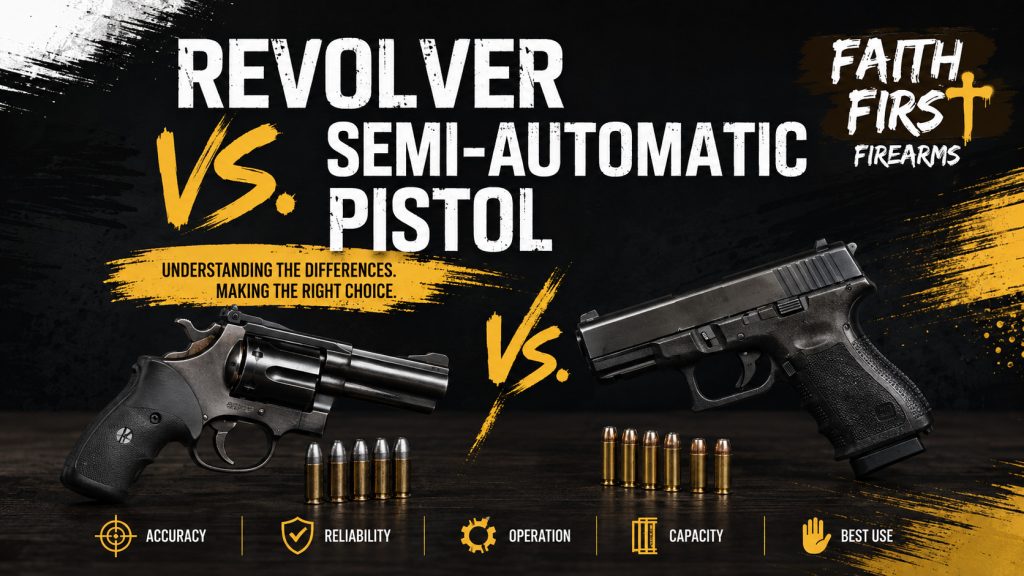
The usual framing for this comparison is “which one is more reliable,” and that is the wrong question. Both designs work. They fail differently, they load differently, and they ask different things of the person holding them — and one of those differences will matter far more to you than the others. A revolver has fewer steps to operate, but the trigger press is commonly longer and heavier and the capacity is lower. A semi-automatic generally holds more, reloads faster once learned, and asks you to learn more procedures. Neither is automatically the right first handgun. The useful comparison is against your hand strength, your realistic practice schedule, and what you actually intend to do with it.
Two words first, because the rest depends on them. A double-action trigger both cocks and releases the firing mechanism in one press, which is why that press is longer. A single-action trigger only releases a mechanism that is already cocked, which is why that press is shorter.
Somebody told you to get a revolver because it is simpler. That advice has a real basis: there is no magazine to seat, no slide to rack, no external safety on most designs, and the failure you are most likely to encounter is resolved by pressing the trigger again. For a person who will not practice much, that genuinely is fewer things to remember. The person who told you this was not making it up.
Somebody else told you nobody carries a revolver anymore. That also has a basis — modern semi-automatic pistols dominate the market, hold more, and are what most instructors teach on. That person is describing something real too.
Both are describing one true thing and treating it as the whole picture. What neither of them mentioned is the trigger.
“Revolvers never malfunction.” A malfunction is any interruption of the normal firing cycle. Revolvers have fewer of them and the common one is easy to work around. They are not immune: debris under the extractor star, a high primer, a cartridge case that has expanded, or a bent crane can bind a cylinder — and unlike a semi-automatic stoppage, a bound cylinder is not something you clear on the firing line. It ends the session. Fewer malfunctions is true. Never is not.
“Fewer controls means easier to shoot.” These are different skills. Fewer controls means an easier manual of arms — the set of physical steps you must learn and remember to load, fire, unload, and make the firearm safe. Shooting it well is a separate matter, and this is where the long, heavy double-action press works against a new shooter, because a press that requires more effort is a press that is easier to disturb the sights with.
“Semi-autos are too complicated for a new owner.” There are more steps, and they are learnable — most quickly with a qualified instructor beside you, watching what your hands are actually doing. The question is not whether you can learn them; it is whether you will practice enough to keep them automatic under stress.
“Capacity is the only real difference.” Capacity is the difference people quote because it is a number. Reload speed, trigger press, grip shape, how each type fails, and how easily you can find a holster that fits are all differences a new owner will encounter sooner than they encounter a capacity limit.
The manual of arms. With a revolver: open the cylinder — the rotating part that holds the cartridges — load, close, fire, open, eject, reload. With a semi-automatic: seat a magazine — the removable container that feeds cartridges into the action — rack the slide, fire, and know what to do when the slide does not go fully into battery. The semi-automatic list is longer. Neither list is long enough to be a reason on its own.
Trigger press. This is the fact the genre leaves out, and it is the one most likely to decide this for you. A double-action revolver press is commonly long and heavy relative to a typical semi-automatic press. How long and how heavy varies by model, and the firearm in your hand and its manual are the authorities on that, not this page. What is consistent is the consequence: some hands can manage that press repeatedly and some cannot, and the only way to find out is to press one.
Capacity and reloading. Revolvers generally hold fewer rounds than comparable semi-automatic pistols, and reloading one to a useful standard is a learned skill that takes practice. Swapping a magazine is a shorter skill to acquire. If you expect to practice rarely, weigh that honestly rather than optimistically.
How each type fails. In broad terms: a semi-automatic’s common stoppages are cleared by physical manipulation, and a revolver’s most common problem is resolved by pressing the trigger again — while its less common problems tend to stop the day. That is a conceptual sketch, not instruction. Learning to clear a stoppage safely is a hands-on skill; your firearm’s manual describes the procedure for your specific model, and a qualified instructor is the right person to practise it with.
This is the point where written explanation stops being enough. What comes next is hands-on work with a qualified instructor — and Faith First Firearms does not teach shooting, so that part is arranged separately from anything you buy here.
Shape, concealment, and holsters. A revolver’s cylinder is wide and prints differently under clothing than a flat slide. The more practical issue is availability: fewer holster models are made for many revolver patterns, and holster fit is model-specific. Decide the firearm knowing that the holster decision follows immediately — how to choose a holster.
Cleaning and maintenance. Different geometry, different routine, similar frequency. Both are governed by the manufacturer’s manual.
Home and nightstand. Both are commonly selected. The deciding factors are usually who else in the household may need to operate it and what storage the household has agreed on, not the action type.
Daily carry. Semi-automatic pistols are the more common choice, largely for size, weight, and holster availability. Small revolvers remain a legitimate option and are chosen deliberately by people who have shot both.
Range practice and skill building. A semi-automatic is generally the cheaper and faster platform to build volume on. If your plan is to practise regularly, that matters.
Owners with grip-strength or dexterity considerations. This cuts both ways and it is the reason a blanket answer fails. Racking a slide requires a two-handed pulling motion and grip strength; a heavy double-action press requires sustained finger strength. Someone who cannot comfortably do the first may manage the second, and someone with arthritis in the trigger finger may find the reverse. Loading small cartridges into a cylinder is fine motor work; loading a magazine is different fine motor work. There is no substitute for putting your hands on both. We are appointment-based and online-first rather than a walk-in storefront, so with us that is something to arrange in advance rather than drop in for — and arranging it, with us or anywhere you can handle both types, is the honest answer here rather than a sales line.
Answer these about yourself rather than about the firearms.
Every one of these changes with the person. A consultation lets us ask about yours before anything is recommended.
Take those six answers to a listing page and compare specifications against them rather than against a brand you have heard of. Bring the recommendation your relative gave you along; there is usually something right inside it worth keeping.
What changes this answer is not new information about revolvers. It is one of three things about you: your hand strength, whether anyone else in the house may need to run it, and whether you will actually practise. Change any of those and the better choice changes with it — which is why nobody, including us, can settle it from a page.
Procedures vary by make, model, and generation. Your firearm’s owner’s manual is the controlling source for how your specific firearm loads, unloads, operates, and is maintained. If anything in your manual conflicts with anything here, follow your manual.
This content is provided for general educational purposes and is not legal advice. Firearm laws and regulations may change and can vary by jurisdiction. Verify current federal, state, and local requirements before acting.
Our articles are written and reviewed by the Faith First Firearms Editorial Team. We cite primary sources where a claim depends on one, we say plainly when a question falls outside what we can answer, and we route legal, medical, and instruction questions to people qualified to answer them. Faith First Firearms does not provide firearm training.
Faith. Safety. Responsibility.

Prefer personal guidance on ownership, transfers, or your first purchase? Book a consultation.

You have told us that you are under 18 years old, so we are not able to give you access to this site.
If you would like to learn about firearm safety and responsible ownership, Project ChildSafe offers free educational resources:
I confirm that I am at least 18 years old.