
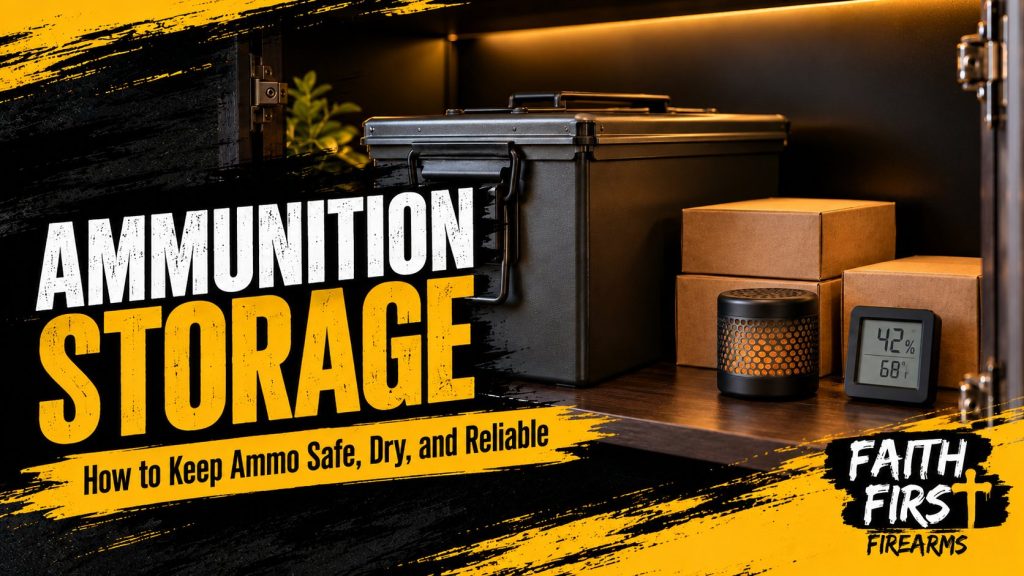
Ammunition is more forgiving than many new owners expect, and much less forgiving of one thing in particular: moisture. Kept in its factory box, somewhere cool, dry and locked, modern ammunition can be expected to stay reliable for a long time. Kept loose in a damp garage, a hot truck or a drawer a child can open, it becomes unreliable, unsafe, or both.
This guide follows the published recommendations of SAAMI, the firearm and ammunition industry’s standards body, and turns them into a practical setup for a Texas home: what damages ammunition, how to store it, how long it lasts, and when a box should be retired instead of fired.
SAAMI notes that factory-fresh ammunition is built to function anywhere from arctic cold to tropical heat. The trouble comes from extended exposure to high temperature, high humidity or chemicals, which can leave a cartridge that fails to fire, fires late, or burns its powder incompletely.
Humidity corrodes brass cases and can work its way toward the primer and powder. Warning signs include green or white deposits on the case and dull, spotted bullets. Rimfire cartridges such as .22 LR are built differently, with the priming compound inside the rim rather than in a separate primer cup, so they are worth keeping especially well sealed.
SAAMI’s long-standing guidance is to avoid extreme temperatures above 150°F, and its storage recommendations advise against leaving ammunition in a vehicle, trunk included, for extended periods in direct sun or heat, because heat speeds the deterioration of the propellant. In a Texas summer, a parked car, an attic or an uninsulated shed are exactly the places to avoid. Our article on why a vehicle is not a place to store a gun covers the same problem from the firearm’s side.
Water, solvents, petroleum products, ammonia and similar chemicals can penetrate a loaded cartridge. SAAMI warns that the result can be a misfire or a “squib,” a round too weak to push its bullet out of the barrel. A bullet lodged in the bore becomes dangerous if another round is fired behind it. In practice, ammunition does not belong on the same shelf as cleaning solvents, and cartridges should never be sprayed with lubricant.
The best spot is usually inside the climate-controlled part of the house: a locked cabinet, a closet that locks, or a safe. Garages, attics, sheds and vehicles swing the furthest in temperature and humidity. If a container has to sit on a concrete floor, raise it on a shelf so it stays off a surface that can hold moisture.
SAAMI recommends keeping ammunition in its original packaging or in packaging designed for the purpose. A sound household setup keeps the factory boxes intact and places them inside a gasketed ammo can or an airtight bin with a desiccant pack. Recharge or replace the desiccant on a schedule, and label the outside of each container with the cartridge name and the date you stored it.
SAAMI recommends storing ammunition separately from firearms and keeping it inaccessible to unauthorized people, with children as the first concern. Separate, locked storage adds a second barrier: someone who reaches one still does not have the other. What secure looks like depends on your household, whether that means young children, visiting grandchildren or roommates, and our Safety and Storage guide walks through the options for the firearms themselves.
If there are children in your home, how you talk with them about firearms matters as much as the lock. Our guide to teaching gun safety at home is a good place to begin.
Use older ammunition first and keep a simple running note of what you have. SAAMI also cautions against two habits that quietly wear out cartridges in a firearm that is loaded and unloaded often: chambering the same round again and again, which can push the bullet deeper into the case and raise pressure, and topping off a magazine without ever cycling the rounds already in it. Empty the magazine periodically, inspect the cartridges, and reload so the older rounds are used first.
Most ammunition carries no printed expiration date, and SAAMI does not publish one. Its guidance is that ammunition kept in factory packaging, through ordinary changes in temperature and humidity, can be expected to perform satisfactorily over extended periods in a firearm that is in proper working order. Condition matters far more than age: a well-stored box from years ago can be in better shape than a newer one left in a truck.
SAAMI’s rule is simple: inspect before use, and if in doubt, do not chamber or fire it. Set aside any cartridge or shell that shows:
If a round ever sounds or feels noticeably weak when fired, stop. Keep the muzzle pointed in a safe direction, unload, and make sure the barrel is clear before firing again.
SAAMI’s testing shows that stored ammunition does not mass-detonate. A cartridge that ignites outside a firearm’s chamber bursts inefficiently; the bullet rarely travels far, and small case or primer fragments usually travel no more than about 50 feet. That is a reason for calm, not carelessness. Fragments can still injure, and a round chambered in a firearm behaves as if the trigger were pulled.
Properly packaged ammunition is designed to survive the drop, vibration and rough-handling tests of commercial shipping. SAAMI does note that an individual cartridge can ignite if its primer is struck, so loose rounds still deserve careful handling.
Ammunition degrades from conditions, not birthdays. Store it well, inspect it before use, and age becomes a much smaller question.
Never bury unwanted ammunition or throw it into a pond or creek; SAAMI warns that it can be found years later, still live. Disposal must follow federal, state and local rules, and SAAMI suggests your local law enforcement agency, fire department or a shooting facility as places to ask. Ammunition from a manufacturer you can identify may also be returnable to that manufacturer, so contact them first.
Storing ammunition well is not dramatic. It is a dry box, a locked cabinet and the habit of looking before loading. That is exactly why it matters: responsible ownership is built from small, faithful routines practiced long before anything goes wrong.
This content is provided for general educational purposes and is not legal advice. Firearm laws and regulations may change and can vary by jurisdiction. Verify current federal, state, and local requirements before acting.
Our articles are written and reviewed by the Faith First Firearms Editorial Team. We cite primary sources where a claim depends on one, we say plainly when a question falls outside what we can answer, and we route legal, medical, and instruction questions to people qualified to answer them. Faith First Firearms does not provide firearm training.
Faith. Safety. Responsibility.
Prefer personal guidance on ownership, transfers, or your first purchase? Book a consultation.

You have told us that you are under 18 years old, so we are not able to give you access to this site.
If you would like to learn about firearm safety and responsible ownership, Project ChildSafe offers free educational resources:
I confirm that I am at least 18 years old.