
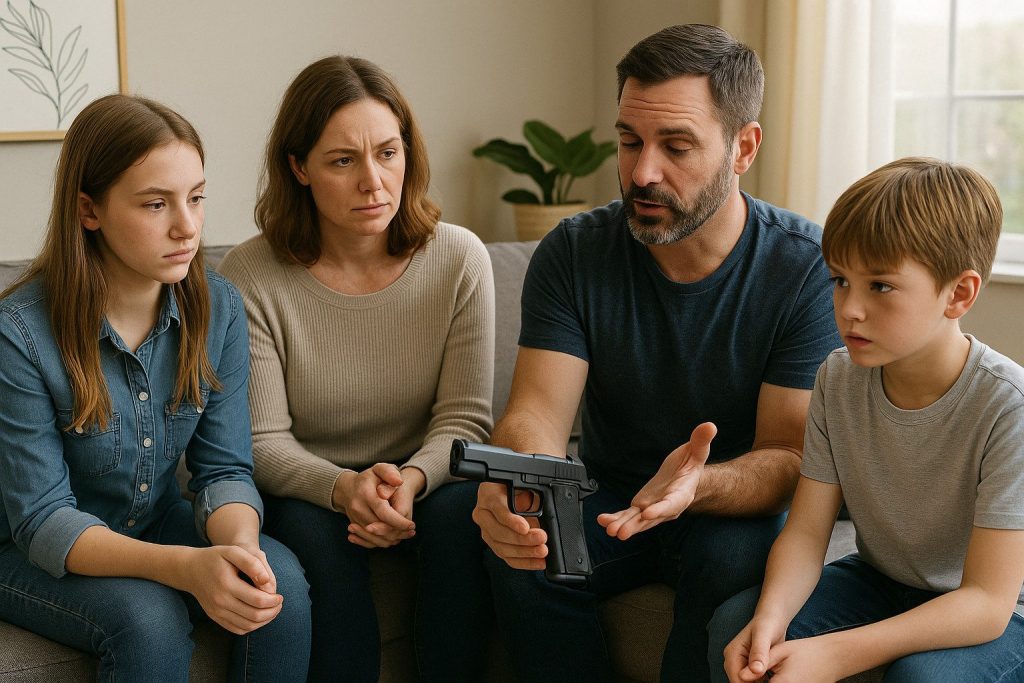
Whether your household includes one firearm or an entire collection, the foundation of safety is communication. Firearms shouldn’t be a mystery, a secret, or a taboo subject — they should be understood, respected, and discussed openly.
Creating a culture of responsibility in your home builds confidence, reduces fear, and ensures that every person under your roof knows how to respond safely around firearms — especially in unexpected situations.
Children are naturally curious. Avoiding the topic doesn’t remove that curiosity — it increases it.
You don’t need to go into technical detail, but you should clearly explain that firearms are powerful tools, not toys, and must always be handled with respect.
Stop. Don’t touch. Leave the area. Tell an adult.
Make it simple, repeatable, and memorable.
Why your family chooses to own firearms
The importance of locked and secure storage
Your expectations for safe behavior
What to do in emergency scenarios
Honest communication helps everyone feel safe and informed.
Every home with firearms should have a written and clearly understood set of rules. These standards protect both your family and the integrity of your home.
Post them somewhere visible — near your safe, in a mudroom, or in a family binder.
Always treat every firearm as if it’s loaded.
Never point a gun at anything you don’t intend to shoot.
Keep your finger off the trigger until ready to fire.
Know your target and what’s beyond it.
Only adults may access or handle firearms unless supervised.
Consistency builds trust and removes guesswork.
Your family will follow what you do, not just what you say.
If you handle firearms casually or skip critical safety steps, your household will assume this behavior is acceptable.
Responsible leadership means demonstrating:
Proper muzzle discipline
Safe handling practices
Consistent use of safety gear
Locking up firearms every single time
Respect for each weapon, whether loaded or unloaded
Your daily habits become your family’s standard.
Firearm safety isn’t a one-and-done conversation — it’s a lifelong learning process.
Take your spouse or teen to a certified firearm safety class
Practice range etiquette together
Watch reputable firearm safety videos as a family
Talk through “what-if” scenarios
Review safety rules every time you clean or handle a firearm
Education builds confidence and eliminates panic or uncertainty.
As believers, we know that stewardship extends to every aspect of our lives — including the tools God has entrusted to us. Teaching responsible firearm safety in your home:
Protects your family
Honors God through wisdom and self-control
Demonstrates love for others
Builds confidence rooted in responsibility, not fear
“The wise store up knowledge.” — Proverbs 10:14
Teaching your family to handle firearms responsibly is one of the clearest ways to demonstrate wisdom, care, and leadership.
This content is provided for general educational purposes and is not legal advice. Firearm laws and regulations may change and can vary by jurisdiction. Verify current federal, state, and local requirements before acting.
Our articles are written and reviewed by the Faith First Firearms Editorial Team. We cite primary sources where a claim depends on one, we say plainly when a question falls outside what we can answer, and we route legal, medical, and instruction questions to people qualified to answer them. Faith First Firearms does not provide firearm training.
Faith. Safety. Responsibility.

Prefer personal guidance on ownership, transfers, or your first purchase? Book a consultation.

You have told us that you are under 18 years old, so we are not able to give you access to this site.
If you would like to learn about firearm safety and responsible ownership, Project ChildSafe offers free educational resources:
I confirm that I am at least 18 years old.