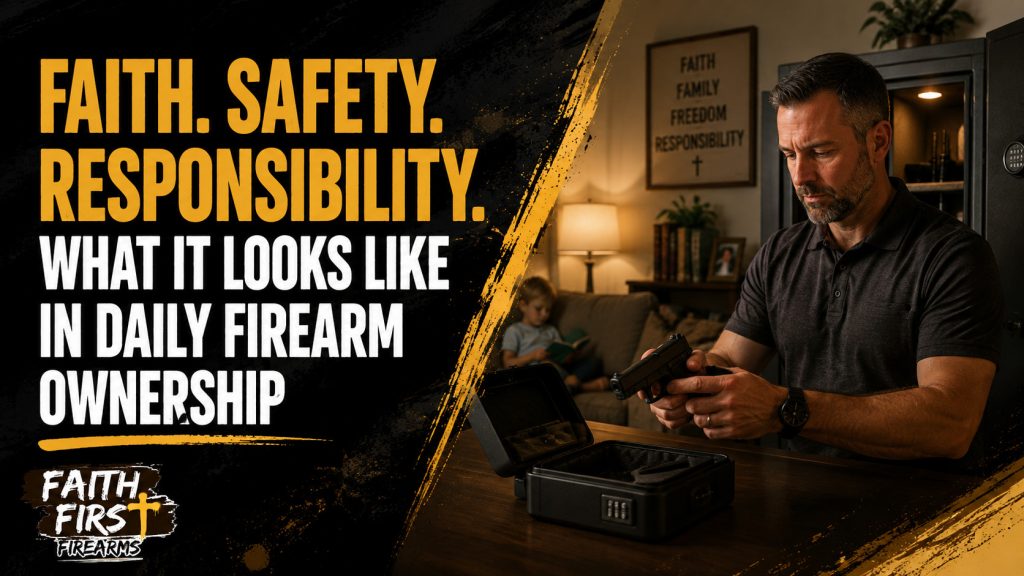
Most people who ask about our mission are asking a narrower question underneath it: this sounds right, but what am I supposed to actually do differently?
That is a fair question and it is slightly the wrong shape. It assumes the answer is a posture — something you adopt and then maintain. It is closer to an order of operations. Faith is the reason the standard exists. Safety is how the standard gets practised on a Tuesday. Responsibility is what the first two produce over time, which makes it an outcome rather than an effort.
In ordinary ownership that sequence lands in four places: what you buy, how you secure it, what you go and learn from somebody qualified, and what the people you live with know. Most owners have genuinely finished two of them.
The useful question is which two.
The three words are not a ranking of importance and they are not interchangeable. Read backwards they invert into something else entirely — responsibility as the reason, safety as the method, faith as the result — and that describes self-improvement rather than stewardship. Read forwards, faith supplies the reason a standard exists at all: the people in your house are not yours to gamble with. Safety is the daily form that conviction takes. What accumulates when the first two are practised long enough to become unremarkable is the third.
The scriptural and ethical foundation underneath that — protecting rather than punishing, de-escalating rather than escalating, preserving life rather than asserting dominance — is not restated here. Our foundation article on faith and protection carries it, and carries it better than a summary would.
The objection worth taking seriously is not that preparing is unwise. It is that preparing looks like a failure of trust — that someone who secures a home has quietly decided God will not.
The tell that the objection runs backwards is what finished work actually feels like. It is quiet. A household that settled its storage question two years ago does not think about storage. Nobody in it rehearses scenarios in the dark. The decision was made once, calmly, on an ordinary afternoon, and then it stopped asking for attention.
The unfinished decision behaves differently. It talks to you. It surfaces when a child’s friend comes over, when you leave for a week, when somebody asks a question you cannot answer cleanly. Living braced is not the price of getting ready. It is the price of not having finished.
None of that is a claim about how much protection any particular lock provides. It is a claim about where your attention goes. Work done in advance frees you from carrying it around, and being freed from carrying it around is the whole point.
The first decision is not which model. It is whether the purchase, as currently planned, is finishable.
A firearm is the visible part of a larger cost. Storage, ammunition, eye and ear protection, cleaning supplies, and instruction are part of what you are taking on whether or not they appear on the receipt. If the budget covers the firearm but not the means to secure it, the budget does not cover the firearm yet. That is not a comfortable sentence for a retailer to publish.
So the honest version of this decision includes three answers most stores do not offer: buy less, buy later, or do not buy this one. We will recommend a cheaper firearm than the one you came for when the cheaper one is the one you will actually shoot, because a rimfire that gets used every month teaches more than a handgun that lives in a drawer. Sometimes the recommendation is simply a delay. The reason to ask what a firearm is for before asking which one is that the first question can be answered honestly and the second cannot be answered at all without it.
This is the decision owners postpone longest, and it is the one that changes a household most.
The organising question is not which product. It is how fast you need access, because that single answer eliminates most of the options before you have compared any of them. A firearm you want reachable in seconds and a firearm you want inaccessible to everyone but you are two different problems. A home with children, with guests, or with anyone whose access you have not actually thought about is solving the second problem whether or not it has said so out loud. Most households end up with more than one solution, and that is a normal outcome rather than a failure to decide.
Make the decision before the firearm comes home rather than after. The order matters more than the product does, and the version of this that goes wrong is almost always the one where the firearm arrived first and the storage was going to get sorted out that weekend.
Where home is not the right answer at all — a move, a long absence, an estate being worked through — professional storage is a legitimate answer rather than an admission of anything.
Two parts of ordinary ownership cannot be learned from writing, and both are worth naming plainly rather than implying that a thorough enough article would cover them.
The first is handling. Nobody can watch their own grip, catch their own muzzle drift, or feel a flinch developing. Written material can get you ready for a range, explain what the four rules mean in practice — the National Shooting Sports Foundation publishes them, and this library uses that wording throughout — and describe what a good session looks like. It cannot correct you, because it cannot see you. Faith First Firearms does not teach shooting. First Shot Training (opens in new tab) is the training brand in this family of businesses and currently provides Texas License to Carry education online; hands-on instruction is something to confirm with a qualified instructor, based on the specific thing you are trying to learn. We would rather explain that at this length than let the word “training” quietly do work it cannot do.
The second is the bench. There is a point in every disassembly where the next step stops being obvious, and pushing past it is how a maintenance task turns into a repair. For firearm-service or bench-work questions, contact us for a consultation and we can help you determine the appropriate next step. Your manufacturer’s manual is the first authority and a gunsmith is the second. Knowing where your own limit sits is a skill, and it is one of the few that improves simply by admitting it exists.
Written education can get you ready. It cannot stand in for qualified hands-on instruction, and pretending otherwise would cost you more than it costs us to say so.
The fourth decision has other people in it, which is why it is usually last: nothing forces it.
Who knows the firearm exists. Who knows where it is. What a child is told, at what age, in what words. What a guest is told, if anything. What happens if you are not home and somebody else needs to know — or needs specifically to be unable to reach it. That is not one conversation. It is a short series of them, and they go better scheduled than triggered.
The part owners skip entirely is the last one: what happens to the firearm when you are not here at all. A firearm left in an estate with no record, no context, and nobody who knows what it is becomes a problem handed to people already having the worst month of their lives. Writing down what you own and where it is takes an evening.
One more thing belongs here, though it faces outward. Somebody will eventually ask your advice because you own one and they do not. The useful answer is almost never a recommendation. It is these four decisions, in order, asked back as questions. Being the person who asks what the firearm is for, rather than the person who names a model, is most of what helping a new owner actually consists of — and quiet competence persuades better than expertise on display.
Pick one and give it this week rather than this year.
One of those three is the one you already know you have been avoiding. That is the one. It will take an evening, and by next week you will not be thinking about it — which, when this is working, is exactly what it is supposed to feel like.
This content is provided for general educational purposes and is not legal advice. Firearm laws and regulations may change and can vary by jurisdiction. Verify current federal, state, and local requirements before acting.
Our articles are written and reviewed by the Faith First Firearms Editorial Team. We cite primary sources where a claim depends on one, we say plainly when a question falls outside what we can answer, and we route legal, medical, and instruction questions to people qualified to answer them. Faith First Firearms does not provide firearm training.
Faith. Safety. Responsibility.
Prefer personal guidance on ownership, transfers, or your first purchase? Book a consultation.

You have told us that you are under 18 years old, so we are not able to give you access to this site.
If you would like to learn about firearm safety and responsible ownership, Project ChildSafe offers free educational resources:
I confirm that I am at least 18 years old.