
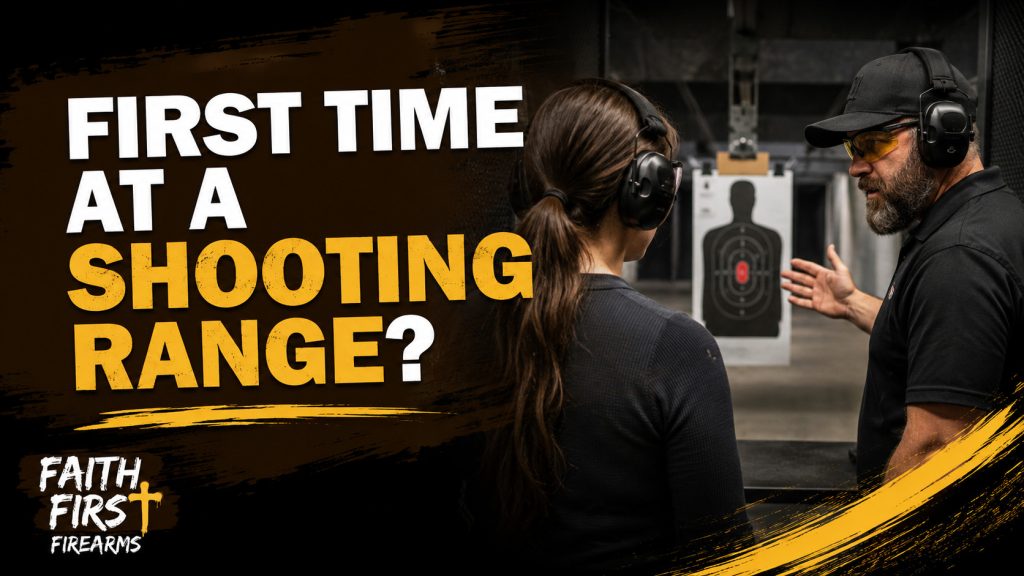
You own a firearm, it is in a case by the door, and you have not taken it anywhere because you are not certain what happens when you walk in. Here is the shape of it: you check in and sign something, you get a short safety briefing and a lane, you wear eye and ear protection the entire time you are past the door, and there is a staff member whose whole job is to watch and help. It is more structured and more supervised than most people expect. The part worth doing today is not the drive — it is three phone calls, because the things that most often ruin a first visit are decided before you leave the house.
Ranges are independently run and their rules differ genuinely, not cosmetically. Ask these three things when you call, and write the answers down.
Do I need a reservation, and are walk-ins accepted today? Some ranges reserve lanes — the individual shooting positions you stand in — by the hour, some are first-come, and availability moves with weekends and weather.
What ammunition is allowed? This is the most common reason someone drives home without shooting. Ranges restrict ammunition types for reasons connected to their backstops and ventilation. Ask specifically, using the caliber and type printed on your box. And separately from anything the range says: use only ammunition designated by your firearm’s manufacturer. A cartridge fitting the chamber does not mean it is safe to fire in that firearm, and your owner’s manual is the authority on which ones are.
May a new shooter shoot alone? Some ranges require a first-time shooter to be accompanied, to take an orientation, or to book with staff. If the answer is no and you arrive by yourself, the visit is over before it starts. Ask it as an open question rather than a yes-or-no one, because if an orientation exists it is worth knowing what it covers.
Two smaller questions are worth adding if the call is going well: whether you may draw from a holster (frequently not, and frequently not for a first-timer), and whether the firearm should arrive cased.
Expect a counter, an identification check, and a waiver — a document in which you acknowledge the risks and agree to follow the range’s rules. Read it rather than signing it blind; it usually contains the rules you are agreeing to.
Expect a short safety briefing. It may be a video, a card, or a person talking to you for four minutes. It will cover the range’s own commands and its specific prohibitions, and that briefing is the authority for that range — it outranks anything you read online, including this page.
You will be told when to put on eye and ear protection. The answer is nearly always “before you go through the door to the range floor, and until you come back out.”
A range safety officer, usually called an RSO, is a staff member whose function is to watch the line and intervene. They are not evaluating your marksmanship. They are watching where muzzles point and where fingers are.
Being corrected is not being scolded. An RSO who tells you to keep the muzzle downrange is doing the thing they are there for, and they will say the same sentence to somebody with thirty years of experience later that afternoon.
How to ask for help without feeling foolish: say the specific thing. “I don’t know how to load this magazine.” “The slide isn’t going all the way forward and I don’t know why.” “Can you watch me do this once?” Specific questions get useful answers; “am I doing this right?” gets a shrug. If you do not know a word for the part you mean, point at it — nobody in that building learned the vocabulary before they learned the object.
You will be shown to a lane or a bay — a wider partitioned area, more common at outdoor ranges. There will be a bench or shelf. Put the cased firearm on it and open the case there, not in the parking lot.
Ranges use a small vocabulary of commands. The exact wording varies, which is why the briefing matters, but the concepts are consistent. A cease fire means stop immediately: finger off the trigger, firearm down and pointed downrange, hands off, step back, wait. A cold range means no one is handling firearms, usually because people are downrange changing targets. A hot range means the line is live again. If you ever hear a command and are not sure what it means, do the safest version: stop, unload if you know how, step back, and ask.
The four handling rules apply at a lane exactly as they apply anywhere. NSSF states them, in this order: keep the muzzle pointed in a safe direction; treat every firearm as though it is loaded; keep your finger off the trigger until you are ready to shoot; be sure of your target and what is beyond it. On a range, the first one has an easy answer — downrange, always, including while the firearm is on the bench.
Load the first magazine light. Two or three rounds, fired slowly, with a pause after each. You are not testing your accuracy; you are finding out what the recoil, the noise, and the timing feel like with your own hands on your own firearm. Then load a few more. There is no schedule.
Do not handle a firearm — yours or anyone’s — while anyone is downrange. Do not pick up someone else’s firearm without being asked. Do not cross behind another shooter with a firearm in your hands. Leave brass on the floor unless the range says otherwise. Keep the muzzle downrange while you clear a stoppage, and if you do not know how to clear it, stop and get the RSO rather than turning around holding the firearm.
Stop when the firearm does something you cannot explain. Stop when your hands start shaking, which happens and is not a verdict on you. Stop when you notice you are anticipating the shot and pushing the muzzle down before it fires — that habit is easier to interrupt in the first session than to unlearn in the tenth.
Stopping mid-session is normal. A first visit that lasts twenty minutes and ends because you had had enough is a successful first visit.
Clean it, or at minimum find out from your owner’s manual what your firearm needs after firing and when. Then put it back into whatever storage your household has agreed on, and store ammunition in a locked location separate from the firearm.
Write down two things while they are fresh: what you could not do, and what you want to ask somebody next time. That short list is worth more than the target you brought home.
Nearly everything above is logistics, and logistics is the part an article can carry. Technique is not. Nobody can see their own grip, their own trigger press, or their own flinch, and a habit built in the wrong direction during a first session is harder to interrupt later than it would have been to avoid.
Two things already in this article point at the same answer from different directions, and it is worth putting them together before you go. The first is the third phone call — may a new shooter shoot alone? — which exists because some ranges answer it by offering an orientation or by asking you to book with staff. If that is what you are told, that is not an obstacle; it is the supervised start this section is about, and it is worth asking what it covers. The second is the range safety officer, who is already on the line, already watching, and already the right person to hear “can you watch me do this once?”
If a range you are visiting offers an orientation or has staff available on the line, that is a legitimate place to start asking.
Faith First Firearms sells firearms, runs transfers, stores and services them, and helps owners work out what they need. We do not teach shooting, we do not run a range, and we do not rent lanes — which is precisely why this page has nothing to sell you and no reason to talk you into a drive. If you have owned the firearm for a while and have not taken it out yet, the honest next step is one of the three phone calls at the top of this page, not a purchase.
Safe-handling content is adapted from the National Shooting Sports Foundation’s “4 Primary Rules of Firearm Safety” (nssf.org). Retrieved August 8, 2026. Range rules vary; the range’s own posted rules and briefing govern.
This content is provided for general educational purposes and is not legal advice. Firearm laws and regulations may change and can vary by jurisdiction. Verify current federal, state, and local requirements before acting.
Our articles are written and reviewed by the Faith First Firearms Editorial Team. We cite primary sources where a claim depends on one, we say plainly when a question falls outside what we can answer, and we route legal, medical, and instruction questions to people qualified to answer them. Faith First Firearms does not provide firearm training.
Faith. Safety. Responsibility.

Prefer personal guidance on ownership, transfers, or your first purchase? Book a consultation.

You have told us that you are under 18 years old, so we are not able to give you access to this site.
If you would like to learn about firearm safety and responsible ownership, Project ChildSafe offers free educational resources:
I confirm that I am at least 18 years old.