
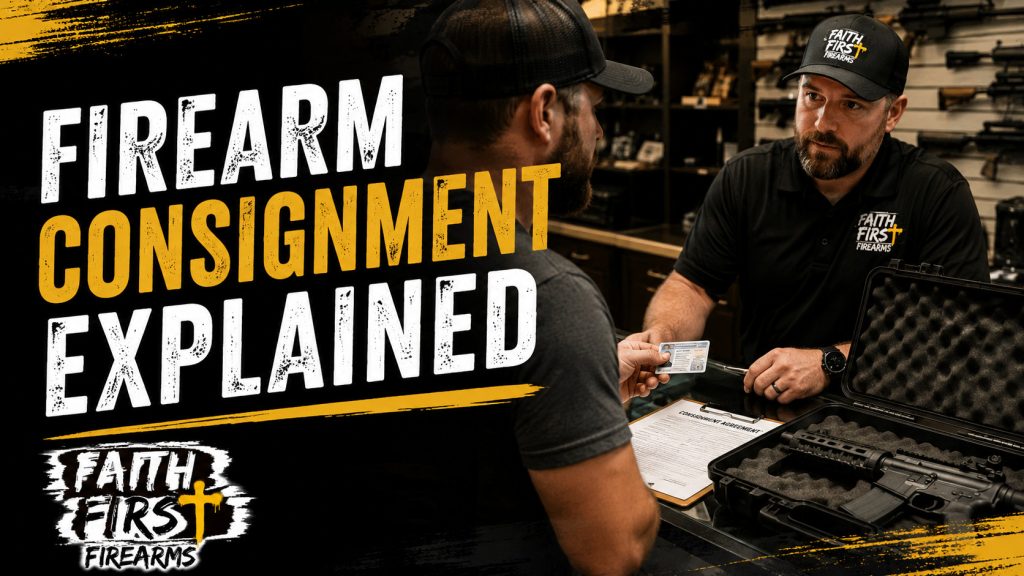
Somewhere in your house there is a firearm you have decided not to keep. Perhaps it never fit your hand. Perhaps you bought it for a purpose you no longer have. Perhaps it came to you and was never really yours. Somebody has told you to look into consignment.
Consignment means you leave the firearm with a licensed dealer, who lists it and sells it on your behalf. You generally remain the owner until it sells. When it does, the dealer completes the transfer with the buyer the same way any dealer sale is completed, takes an agreed fee, and pays you the balance. That is different from selling the firearm outright to a dealer, who pays you straight away and then carries the risk that it may not move.
Most explanations stop there. The part that actually decides whether consignment suits you is the dealer’s half of the arrangement — what happens to the firearm while it sits, and what has to be true before it can be handed to a stranger.
This is general educational information and is not legal advice. Firearm laws and regulations may change and can vary by jurisdiction. Customers remain responsible for verifying current federal, state, and local requirements. Faith First Firearms may require additional documentation or decline a transaction when necessary for safety, compliance, or business-policy reasons.
Consignment is an arrangement in which you keep ownership of something and someone else sells it for you, and is paid for doing so. You are the consignor. The dealer is not buying your firearm; the dealer is doing work on it and getting paid when that work produces a sale.
The dealer in this arrangement holds an FFL — a Federal Firearms License, issued by the federal Bureau of Alcohol, Tobacco, Firearms and Explosives. That licence is what allows the business to receive your firearm, hold it, and release it lawfully to a buyer. What a licensed dealer actually does.
It helps to set consignment beside the two arrangements people confuse it with. In an outright sale, the dealer buys the firearm from you, pays you at that point, and now owns both the firearm and the risk that it sits unsold. In a trade-in, the same thing happens with store credit instead of money. In consignment, you keep the firearm and you keep that risk, and you pay a fee for the dealer’s work when the sale happens.
Faith First Firearms’ consignment service is not currently part of our initial public launch service lineup. This article explains the consignment process and what firearm owners should understand when considering consignment. What Faith First Firearms does not do is buy firearms outright for its own inventory. If being paid today matters more to you than what the firearm eventually brings, that is a different transaction with a different kind of business, and it is worth knowing that before you drive anywhere.
The first reason is reach. A firearm listed by a dealer is seen by buyers a private seller has no practical way to find, and that exposure is most of the difference in what a firearm eventually brings.
The second is that the buyer side stops being your problem. Identifying the buyer and running the required background check is the dealer’s work, done to the dealer’s standard, with the dealer’s licence behind it.
The third reason is the one most consignors actually give when you ask them, and it is a legitimate one: they do not want to manage strangers. A private sale means arranging to meet somebody you do not know, forming a judgement about them on the spot, and handling money. Some owners are comfortable with that. Many are not, and there is nothing soft about deciding you are not.
None of that is free. Convenience has a cost, and in consignment the cost is the fee. We would rather write that in one sentence than dress it up in three. What the fee is and how it is structured belongs on our consignment page, not in an article that will still be sitting here in three years.
Ask what happens if it does not sell before you sign anything, with us or with anyone.
This is the half of consignment that almost never gets explained, and it is the half you are actually buying.
Custody. Your firearm sits in the dealer’s secure storage for the whole listing period. That is physical space, and it is physical responsibility for an object that belongs to somebody else. A dealer who is casual about this is telling you something.
Recordkeeping. A licensee is required to keep records of the firearms it acquires and the firearms it disposes of. A consigned firearm enters those records when it arrives and leaves them when it goes out, and the licensee answers for both entries. Those records are inspected, and they outlast the sale.
Completing a lawful transfer with a buyer you will never meet. The buyer does not simply pay and walk out. Federal regulation provides that a licensee shall not dispose of a firearm to a non-licensee unless the transaction is recorded on a firearms transaction record — Form 4473 — and the licensee must contact the National Instant Criminal Background Check System, usually called NICS, before completing the transfer. All of that happens on your behalf, with a person you never see.
The ability to decline. The licensee is the party legally responsible for the transaction, which means the licensee gets to say no — to a consignment, and to a buyer.
Those four things are what the fee pays for. A dealer who charges nothing for them is either doing them at a loss or not doing all of them.
Bring valid identification. We record who is consigning the firearm, and that is not a formality we can skip.
Beyond identification, confirm what else we need when you book, rather than assuming from what another dealer required. Intake requirements are set by the dealer as well as by law, and they differ. One phone call before the appointment is shorter than a second trip.
Whoever you consign with, there should be a written agreement, and it should be read before it is signed rather than after. At minimum it should say:
If an agreement is silent on any of those six, ask. A dealer who answers all six clearly is a dealer you can predict.
Condition, completeness, original accessories, and documentation all affect what a firearm realistically brings. So does what similar firearms are actually selling for, which is not the same as what they are listed at. We do not publish valuations, because a number written in an article goes stale and yours is specific to your firearm.
The buyer goes through what any buyer goes through at a licensed dealer: identification, the federal form, the background check, and release only if the check permits it. You are not part of that, and you are not asked to be.
When the transfer is complete, the sale is closed out and you are paid the balance after the agreed fee. How that payment is made and on what schedule are terms of your agreement, which is the reason the agreement matters more than the conversation that preceded it.
You are still the owner, so the firearm comes back to you. Find out at the outset how a return is arranged and what it involves. A licensed dealer returning a firearm has its own steps to complete, and those are better understood in advance than discovered at the counter.
We will not take a consignment where the firearm or the situation raises a compliance problem we cannot resolve. In practice that means:
Where a firearm raises a legal, ownership, serialization, National Firearms Act, prohibited-person, or other compliance concern, we may decline the consignment and route the question for appropriate review.
That is not a complete list of everything we would turn down, and we are not going to pretend otherwise. Faith First Firearms reserves the right to decline any consignment at its discretion, subject to applicable law. A list that named every exclusion would imply that anything unnamed is automatically accepted, and no dealer can promise that about a firearm it has not seen.
Consignment is not the right answer for every firearm, and we will tell you when it is not.
A firearm that belonged to someone who has died is a legal-authority question before it is a sales question. Who is entitled to sell it has to be settled first, and that is a matter for the estate and, usually, for an attorney.
Do I still own it while it is listed?
Generally yes. Your written agreement is what confirms it, and that clause is worth locating in the document rather than taking anyone’s word for it, including ours.
Can I change my mind partway through and pull it off the listing?
That depends on what your agreement says about ending the arrangement early, which is a separate question from what happens when the term simply runs out. Some agreements treat the two differently. Read both clauses.
Do I have to be there when it sells?
No. The dealer completes the transfer with the buyer. You are not present, and you are not part of the buyer’s paperwork.
Does the buyer’s background check involve me?
No. It is run on the buyer, who is the person receiving the firearm.
What should I bring with the firearm?
Valid identification, and the firearm’s original case, manual, extra magazines, tools, and any documentation you still have — those affect what it can realistically bring. Confirm anything further when you book, since requirements differ between dealers.
In a consignment arrangement, the dealer lists and markets the firearm on the owner’s behalf while the owner keeps ownership until a sale is completed under the applicable agreement and transfer requirements. What Faith First Firearms does not do is buy firearms outright, settle estates, give legal advice about who owns what, or tell you what your firearm is worth in an article.
And if the honest answer is that you are not ready to part with the firearm at all, that is a legitimate answer too. Consignment will still be here when you are ready.
Recheck interval: 90 days.
This content is provided for general educational purposes and is not legal advice. Firearm laws and regulations may change and can vary by jurisdiction. Verify current federal, state, and local requirements before acting.
Our articles are written and reviewed by the Faith First Firearms Editorial Team. We cite primary sources where a claim depends on one, we say plainly when a question falls outside what we can answer, and we route legal, medical, and instruction questions to people qualified to answer them. Faith First Firearms does not provide firearm training.
Faith. Safety. Responsibility.
Prefer personal guidance on ownership, transfers, or your first purchase? Book a consultation.

You have told us that you are under 18 years old, so we are not able to give you access to this site.
If you would like to learn about firearm safety and responsible ownership, Project ChildSafe offers free educational resources:
I confirm that I am at least 18 years old.