
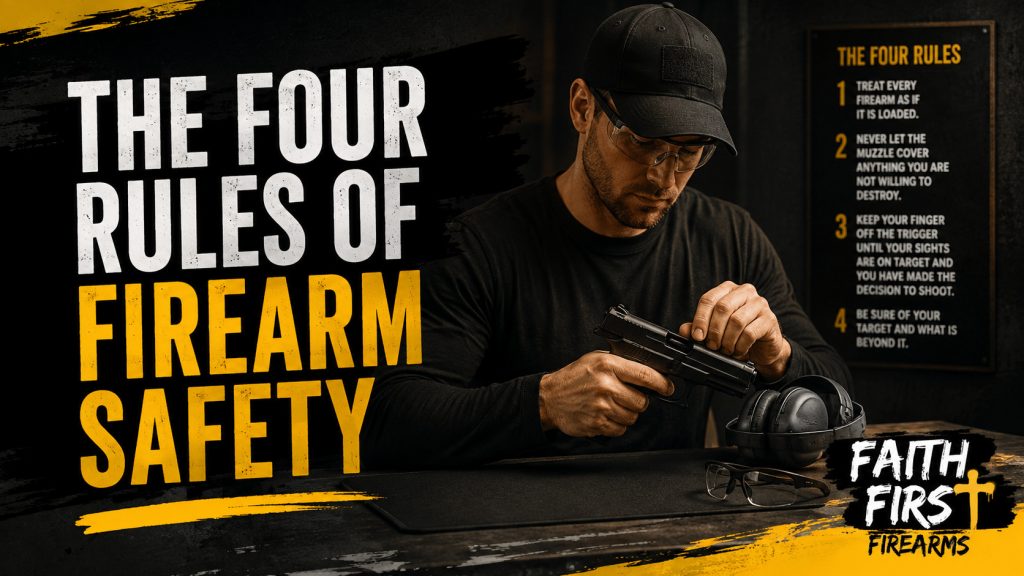
There is no single official set of four rules. The National Shooting Sports Foundation publishes a set of four; it also publishes a separate set of ten; and its Project ChildSafe literature uses a four-item list whose fourth item is different again. Other organisations word theirs differently and count differently. Faith First Firearms uses NSSF’s 4 Primary Rules of Firearm Safety, in NSSF’s own order, and cites it by name each time — because a reader who has heard three versions deserves to know which one they are reading. Paraphrased, that order is: keep the muzzle pointed in a safe direction; treat every firearm as though it is loaded; keep your finger off the trigger until you are ready to shoot; be sure of your target and what is beyond it. Reciting them is easy. This page is about what each one looks like when you are tired, distracted, or handing a firearm to somebody else.
The four rules are not four independent commandments. They are a layered system, and the layering is the point.
Consider what has to go wrong for someone to be hurt. The firearm has to be loaded when the handler believed it was not — rule two failed. The muzzle has to be covering a person — rule one failed. Something has to press the trigger — rule three failed. Any one of those holding stops the injury. A firearm pointed somewhere safe can discharge unexpectedly and hurt nobody. A finger kept outside the trigger guard survives a startle.
That is why “I checked it” is never a reason to relax the other three. The rules are designed on the assumption that you will occasionally be wrong about one of them.
Read that way, the four rules stop being a list to memorise and become a set of habits that cover each other. What follows is what each one looks like, and where each one tends to come apart.
The muzzle is the open end of the barrel — the end a projectile leaves from.
What it looks like followed. You have decided, before you pick the firearm up, where the muzzle is allowed to point in this room. NSSF’s definition is more demanding than the shorthand suggests: a safe direction is one where a discharge could not strike a person, and that judgement has to account for ricochets and for the fact that projectiles pass through interior walls and ceilings. In a single-storey house with people in the next room, “at the wall” is not a safe direction. Depending on the building, safe may be down at an exterior-wall floor joint, or into a loaded bookshelf, or up — and the answer changes when you move to a different room.
Where it breaks. Three moments. Holstering, because that is when the muzzle passes closest to your own leg and hip and your eyes are usually elsewhere. Casing and uncasing at a range, because the case is on a bench at hip height and the firearm rotates as it comes out. And turning to talk to somebody, because the muzzle follows your shoulders and your shoulders follow your attention.
The correction. Pick the safe direction before the firearm is in your hand, and make the direction a property of the room rather than of your intentions. When you turn to speak to someone, move your feet, not just your torso.
What it looks like followed. Every time a firearm comes into your hands, and every time it leaves them, you open the action — the mechanical system that loads and unloads the firearm — and you look. Magazine out first if it has a removable one. Then the chamber, the part of the barrel that holds a cartridge at the moment of firing. You look with your eyes, and where the design allows it you confirm with a finger. Then you leave the action open while it is not in use.
Where it breaks. Almost always at a handoff, and almost always because of confidence rather than carelessness. “I just checked it” three minutes ago. “It’s been in the safe since Tuesday.” Someone hands you a firearm and tells you it is clear. The chamber check that stopped at the magazine well and never reached the chamber — which is the check that misses the round that matters, because a firearm with the magazine removed can still have a cartridge chambered.
The correction. Never accept another person’s word, and do not take your own from ten minutes ago either. Checking in front of the person who just handed it to you is not an insult; among people who handle firearms often it reads as competence.
What it looks like followed. Your trigger finger rests straight along the frame, above the trigger guard, in what is usually called the register position — a fixed, deliberate place for the finger to live, so that it has somewhere to be other than the trigger. It stays there while you load, while you unload, while you carry the firearm across a room, and while you talk. NSSF adds a point that is frequently cut from short versions and should not be: never press the trigger while a manual safety is engaged or partly engaged, because a firearm can discharge at that moment or later, when the safety is released, without the trigger being touched again.
Where it breaks. Under startle, when the whole hand contracts. On a stumble, for the same reason. And in what is called a sympathetic squeeze — when one hand grips hard, for instance to open a door or catch a rail, and the other hand involuntarily does the same.
The correction. Register is a position you train into, not a decision you make. It is also the single easiest thing for someone else to see you doing correctly, which makes it the fastest habit to have corrected by a qualified instructor watching you handle a firearm.
What it looks like followed. You have identified the target positively, and you have accounted for everything behind and around it, because a projectile that misses or passes through keeps going considerably farther than most people estimate. NSSF frames this as knowing what the shot will hit and what lies behind it — the shot cannot be recalled once it is gone.
Where it breaks. This is the rule least likely to fail on a range with a proper backstop and most likely to fail everywhere else — on rural property where the ground rises and falls, at dusk when shapes read as one thing and are another, and in any situation where a person acts before they have finished looking.
The correction. Treat identification and backstop as two separate confirmations rather than one glance. This is also the rule that most rewards knowing the ground you are on before you ever load anything.
All four rules describe what a person does while holding a firearm. They say nothing about the hours when nobody is holding it, and those hours are most of them.
Project ChildSafe’s guidance covers that gap: secure storage that prevents access by children, by anyone who should not have it, and by a thief; ammunition kept in a locked location separate from firearms; and — this part matters — teaching young people about firearm safety as a supplement to secure storage, never as a replacement for it. Deciding which storage suits your household is a separate decision with its own tradeoffs.
Read our Safety & Storage page next if you want the household guidance rather than the handling rules.
Three things on this page will not get you all the way there, and it is worth saying so plainly.
The first is your specific firearm. Where the safety sits, whether it has one, how the action opens, whether it can be dry fired without damage — all of that varies by make, model, and generation, and your owner’s manual is the controlling source. If your manual conflicts with anything here, follow your manual.
The second is the range you are standing on. Ranges publish their own rules, and those rules are binding on you regardless of what you read anywhere else.
The third is your own hands. You cannot see your own muzzle discipline, and you cannot feel a sympathetic squeeze coming. Somebody has to watch you.
Written safety guidance is preparation. Practising it under qualified supervision is the actual work — and Faith First Firearms does not teach shooting, so that part belongs with a qualified instructor rather than with us.
That is the honest limit of an article about safety: it can tell you what to look for and where these four habits usually come apart, and it cannot tell you whether yours have. Only somebody qualified, standing beside you while you handle a firearm, can answer that. It is a separate errand from reading, and it is worth treating as one — put it on the calendar rather than leaving it as an intention.
This is general educational information and is not legal advice or a substitute for qualified instruction. Always follow the instructions and warnings in your firearm’s owner’s manual. Firearm laws and regulations may change and can vary by jurisdiction. Customers remain responsible for verifying current federal, state, and local requirements.
The four rules above are adapted from the National Shooting Sports Foundation’s “4 Primary Rules of Firearm Safety” (nssf.org). Retrieved August 8, 2026. Wordings differ between organisations; this article follows NSSF’s set and NSSF’s ordering.
This content is provided for general educational purposes and is not legal advice. Firearm laws and regulations may change and can vary by jurisdiction. Verify current federal, state, and local requirements before acting.
Our articles are written and reviewed by the Faith First Firearms Editorial Team. We cite primary sources where a claim depends on one, we say plainly when a question falls outside what we can answer, and we route legal, medical, and instruction questions to people qualified to answer them. Faith First Firearms does not provide firearm training.
Faith. Safety. Responsibility.

Prefer personal guidance on ownership, transfers, or your first purchase? Book a consultation.

You have told us that you are under 18 years old, so we are not able to give you access to this site.
If you would like to learn about firearm safety and responsible ownership, Project ChildSafe offers free educational resources:
I confirm that I am at least 18 years old.