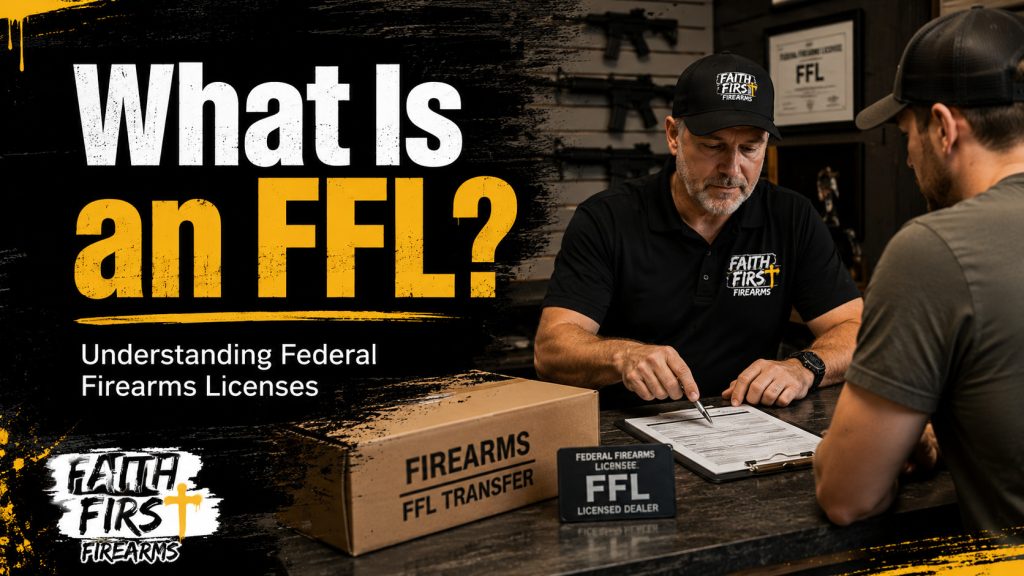
FFL stands for Federal Firearms License — a licence issued by the federal Bureau of Alcohol, Tobacco, Firearms and Explosives, which is usually shortened to ATF. It permits a business or a person to engage in the firearms business. Federal law generally requires that certain firearm sales be completed through a licensed dealer, which is why a firearm bought from an out-of-state seller is normally shipped to a dealer in your own state rather than to your house. You then go to that dealer in person; the dealer records the transaction, checks your identification, runs a background check, and releases the firearm. That last sequence is called a transfer, and it is a service you are buying, not a formality.
This is general educational information and is not legal advice. Firearm laws and regulations may change and can vary by jurisdiction. Customers remain responsible for verifying current federal, state, and local requirements. Faith First Firearms may require additional documentation or decline a transaction when necessary for safety, compliance, or business-policy reasons.
Most of the confusion around this term is not conceptual. It is that one abbreviation carries three meanings and nobody says which one they are using.
When a seller writes “we’ll need your FFL’s information,” they mean the second one: send us the licence document for the business receiving this shipment.
Federal law describes several kinds of firearms business, and a licence is issued for the kind of activity the applicant intends. In plain terms, a dealer sells firearms; a manufacturer makes them; an importer brings them in from abroad; and a collector is licensed narrowly, for curios and relics, rather than for general retail. A single business may hold a licence that covers more than one of these activities.
We are deliberately not publishing a table of licence type numbers here. The number on someone’s licence is not something a customer needs in order to buy a firearm, and a taxonomy you will never use is not education.
What matters to you is narrower: is the business licensed, and will it receive your shipment. That is it.
Faith First Firearms is a Type 07 federal firearms licensee — a licensed manufacturer, and we perform transfers as an appointment-based service. Two practical consequences follow, and it is better to know both now than at the door.
We are not a walk-in storefront. If your mental picture is a showroom with rifles on the wall and a counter you can wander up to on a Saturday, that is not us. We are online-first and appointment-based, which means pickup is scheduled rather than dropped in on.
And being appointment-based or online-first does not make a licensee a lesser one. The licence and the obligations that come with it are the same.
Federal law makes it unlawful for a person other than a licensee to engage in the business of dealing in firearms, or in the course of such business to ship, transport, or receive a firearm in interstate commerce, and it requires a licence before anyone engages in that business at all. Separately, federal regulation prohibits a licensee from selling or delivering a firearm to an unlicensed person whom the licensee knows or has reasonable cause to believe does not reside in the State where the licensee’s premises are located.
Put those together and the “ship it to your FFL” model is the result. A seller in another state cannot lawfully hand you the firearm directly. A licensee in your state can — after doing several specific things in person.
That last phrase is the part worth sitting with. The dealer has to see you. Not your driver’s licence scanned and emailed; not a video call. The verification steps federal law requires are built around a person standing in front of another person, which is why no amount of paperwork sent in advance replaces the appointment.
Choose your receiving dealer before you check out, not after. Our FFL Transfers page explains what to send them.
A transfer is the licensee’s act of receiving a firearm, recording it, verifying who you are, running the required background check, and releasing it to you.
It is worth being equally clear about what a transfer is not.
It is not a registration. Completing a transfer does not enter your firearm into a government registry of owners; the licensee keeps its own required records of the transaction.
It is not a government office. The dealer is a private business carrying out obligations federal law places on it.
And it is not an endorsement of your purchase. A dealer completing a transfer has said nothing about whether the firearm suits you, fits your hand, or is the right choice — which is a separate conversation, and one worth having before you order rather than after.
This is the part most explanations skip, and it is the part that explains everything you will experience at the counter.
Recordkeeping. A licensee must document the firearms it receives and the firearms it disposes of. Those records are the licensee’s legal responsibility and are subject to inspection. This is why a dealer will not “just hand it over” — a firearm leaving without a completed record is the dealer’s problem, permanently.
The federal form. Federal regulation provides that a licensee shall not dispose of a firearm to a non-licensee unless the transaction is recorded on a firearms transaction record, Form 4473. You fill in your portion; the dealer fills in theirs and certifies it. The current edition is ATF Form 5300.9, August 2023 revision.
Identification. The dealer must verify your identity from a valid government-issued identification document. If the address on your identification is not current, that is a solvable problem, but it is one to solve before the appointment rather than at it.
The background check. Before completing the transfer, the licensee contacts the National Instant Criminal Background Check System — NICS — operated by the FBI. There are three possible outcomes and they have different consequences for your day.
The decision to decline. A licensee is the party legally responsible for the transaction, which means a licensee can decline one. Faith First Firearms may require additional documentation or decline a transaction when necessary for safety, compliance, or business-policy reasons. That is not a threat aimed at you; it is the honest consequence of the previous four paragraphs. The person whose licence is on the line gets to be careful.
Everything above costs the dealer time, attention, and record-retention obligations that outlast the sale. That is what the transfer fee is for. We would rather explain that than apologise for it — and our current fee schedule lives on our FFL Transfers page rather than in this article, so that one page carries the numbers and nothing goes stale here.
Three things, and they are all straightforward.
Answer accurately. The form is a federal document and you certify your answers on it.
Bring valid, current identification, and sort out any address mismatch in advance.
Know your own state’s rules. Federal law is a floor, not the whole picture. States add requirements, and some add restrictions on particular firearms or configurations.
A summary. Each step has its own details this page would bury.
One — you choose the receiving dealer, before ordering. Sellers ask for the dealer’s licence at checkout.
Two — the seller ships to that dealer. Any person may ship a firearm directly to a licensee in any state. Handguns cannot go through the United States Postal Service but may travel by common or contract carrier.
Three — the dealer receives and logs it, verifying the shipping licensee’s status.
Four — you are contacted and you schedule. Here, that means requesting an FFL transfer appointment.
Five — you appear in person and complete the Form 4473.
Six — the background check runs, and the firearm is released or it is not.
Can a firearm ship straight to my house?
Generally not, when you are buying from a licensed seller in another state. The firearm goes to a licensee in your state and you collect it in person. Different rules can apply to some antique firearms and to certain intrastate situations, which is a question to ask before you order rather than after.
Does the dealer keep a copy of my paperwork?
Yes. Licensees are required to keep records of the firearms they receive and dispose of, including the completed transaction record. Those records stay with the licensee; how long they must be retained is fixed by federal regulation, and your dealer can tell you what applies.
Is there always a fee?
There is normally a fee for receiving and transferring a firearm you bought elsewhere, because it is work performed on your behalf. Fees vary between dealers and are published on our FFL Transfers page rather than quoted here.
Can any dealer receive my order?
Any licensee may, but not every licensee will. Receiving transfers is a service a business chooses to offer, and some do not, or will not accept shipments from certain sellers. Ask before you order.
Do I need an FFL to own a firearm?
No. A licence is for engaging in the firearms business. Ordinary ownership does not require one.
Two things on this page are worth confirming for yourself rather than taking from an article. The first is your own state’s requirements, because federal law is a floor and your state may add to it. The second is the specific dealer you are about to name at checkout: ask whether they accept transfers, from which sellers, what they need from you, and what they charge — before the firearm is in a box with their address on it. A dealer who answers those four questions clearly on the phone will be straightforward on the day, and a dealer who will not is telling you something useful.
Note on volatility: ATF has a pending proposed rule that would revise the Form 4473 and related timeframes (91 FR 25432, May 8, 2026). It is not in effect. This article is rechecked at 90-day intervals.
This content is provided for general educational purposes and is not legal advice. Firearm laws and regulations may change and can vary by jurisdiction. Verify current federal, state, and local requirements before acting.
Our articles are written and reviewed by the Faith First Firearms Editorial Team. We cite primary sources where a claim depends on one, we say plainly when a question falls outside what we can answer, and we route legal, medical, and instruction questions to people qualified to answer them. Faith First Firearms does not provide firearm training.
Faith. Safety. Responsibility.

Prefer personal guidance on ownership, transfers, or your first purchase? Book a consultation.

You have told us that you are under 18 years old, so we are not able to give you access to this site.
If you would like to learn about firearm safety and responsible ownership, Project ChildSafe offers free educational resources:
I confirm that I am at least 18 years old.